Daily Chores: The Power of a Simple Printable Chart
In the quiet moments of early morning or the winding down of evening, the thought of daily chores can feel like a weight. For kids, adults, roommates, or entire families, these responsibilities are the threads that hold a household together, yet managing them often becomes a source of friction and forgotten tasks. This is where a simple tool transforms obligation into organization: a daily chore chart.
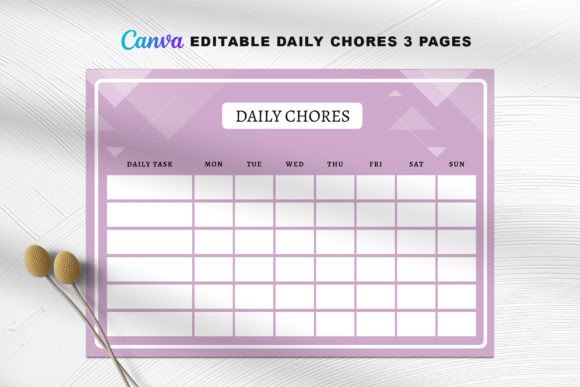
The beauty lies not in complexity, but in clarity. The idea behind the Daily Chores template is elegantly straightforward. It is a printable PDF and JPG, structured as a three-page A4 landscape design, offering a visual framework to assign, track, and complete household tasks. Its core utility is its adaptability. With access to a free or professional Canva account, this template becomes a dynamic canvas, not a static sheet.
Beyond the Household: A Template for Creative Control
What makes this particular chore chart interesting is its inherent invitation to customization. It acknowledges that no two homes, teams, or individuals operate the same way. The stated features—the ability to change fonts, colors, element sizes, orientation, and to add or delete any text—are not just technical specifications. They are permissions for creative ownership.
This transforms the chart from a generic checklist into a personalized system. A parent might use bright, playful colors and icons for a child’s chart, turning chores into a game. Roommates could adopt a sleek, minimalist design with clear columns for each person, fostering accountability without conflict. An entrepreneur using the chart for personal task management alongside business goals might integrate a more serious palette and professional typography. The template becomes a starting point, a structure upon which you build a system that reflects your style and meets your specific needs.
Practical Applications and Audience Adaptations
The utility of an editable chore chart extends far beyond tracking who washes the dishes. For the diverse audience of creators, marketers, educators, and small business owners, this concept can be repurposed into powerful tools for productivity and collaboration.
A blogger or content creator could adapt the Daily Chores template into a weekly content calendar. Columns become days of the week, tasks transform into blog topics, social media posts, or email campaigns. The visual layout ensures a balanced workflow and prevents last-minute scrambling. An educator might redesign it as a classroom responsibility chart or a project milestone tracker for students, teaching accountability through a clear, shared visual. Freelancers juggling multiple clients can use it to compartmentalize daily tasks per project, ensuring nothing falls through the cracks between communications, deliverables, and administrative work.
In each case, the principle remains: visual organization reduces mental clutter. By externalizing responsibilities onto a well-designed page, you free up cognitive space for the actual work, the creative thinking, or the meaningful interaction.
Maintaining Effectiveness Through Customization
The freedom to edit is powerful, but the goal is always effectiveness. When adapting the template, keep the end-user in mind. Is the chart for a young child? Then simplicity, large text, and pictorial elements are key. Is it for a team of adult roommates or co-workers? Clarity, fairness in task distribution, and a clean design will support harmony.
Consider consistency. If you change colors, use them to code categories—blue for cleaning, green for outdoor tasks, orange for administrative chores. If you alter fonts, ensure they remain highly legible. The orientation shift from landscape to portrait might be better for a chart posted on a narrow refrigerator side, while landscape suits a broader family command center on a wall. Adding elements should enhance function; a small checkbox column, a notes area for special instructions, or a reward sticker space for kids can add useful dimensions.
The key is to start with the template’s clean structure and modify only what serves your specific purpose. Avoid over-designing to the point where the chart becomes confusing. Its primary job is to communicate who does what and when with unambiguous ease.
A Foundation for Routine and Independence
For families, the tangible nature of a printed chart, placed in a common area, acts as a constant, gentle reminder. It depersonalizes the nagging. The chore is on the chart, not in a parent’s repeated request. It teaches children planning and responsibility, offering them a clear view of their contributions to the household. For adults and roommates, it eliminates the “I thought you were doing it” conversations, replacing them with a shared, agreed-upon plan.
The Daily Chores template, especially in its editable form, respects that life is not static. Chores change, schedules shift, new responsibilities emerge. With the ability to delete and add elements, the chart can evolve weekly or monthly. This week might include “garden cleanup,” next week “holiday decoration storage.” The system is sustainable because it is adaptable.
From Template to Tangible Results
Having the files in both printable PDF and editable formats via Canva bridges the gap between immediate use and long-term adaptation. You can print and start today, gaining the immediate benefit of organization. Later, as you identify what works and what doesn’t, you can log into Canva and tweak the design. This iterative process means your chore chart gets smarter and more tailored over time.
For commercial use, as permitted by the template’s terms, designers and small business owners could use this as a base to create branded chore charts for clients, perhaps as part of a family organization service or a lifestyle blogger’s printables. The editable nature means they can infuse their own brand colors, logos, and stylistic touches efficiently, offering a valuable product born from a versatile template.
Ultimately, the Daily Chores chart is more than a piece of paper. It is a method for introducing order, reducing conflict, and teaching responsibility. Its simplicity is its strength, and its customizability ensures that strength can be directed exactly where you need it—in a bustling family home, a collaborative shared living space, or the organized mind of a creative professional managing both home and work. By taking this simple framework and making it your own, you turn daily obligations into a clear, manageable, and even satisfying part of your routine.