Assorted Cryptograms Word Puzzles: A Content Creator's Flexible Toolkit
For content creators, educators, and entrepreneurs in the self-publishing space, the act of building a product is often a project of assembly and adaptation. Resources that offer both ready-to-use material and the freedom to customize are invaluable. A set of 23 Assorted Cryptograms Word Puzzles represents exactly this type of asset: a foundational toolkit designed for integration into broader creative workflows, particularly for those producing activity books for platforms like Amazon KDP (Kindle Direct Publishing).
The Core Asset and Its Place in the Publishing Process
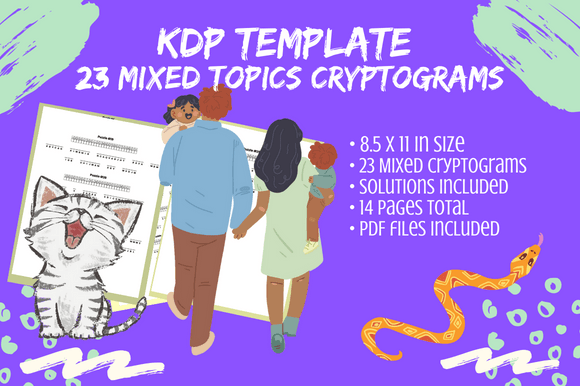
At its simplest, this collection is a digital PDF file containing 23 distinct cryptogram puzzles and their corresponding solutions, formatted for an 8.5 x 11 inch page size without bleed. A cryptogram, a type of puzzle where a quotation is encoded with a simple letter substitution cipher, offers engaging cognitive exercise, appealing to an adult audience seeking entertainment or mental stimulation. The "assorted" nature implies variety in quotation themes and difficulty, which is crucial for creating a compelling product. However, the true utility of this asset lies not merely in its immediate use but in its role as a modular component within a multi-stage publishing process.
This set fits logically into the content aggregation and layout phase. After conceptualizing an activity book—defining its target audience, theme, and length—a creator sources various elements: puzzles, games, coloring pages, and instructional content. Here, the cryptograms packet acts as a substantial, pre-designed fill. Its 14-page structure provides a significant chunk of interior pages, immediately solving part of the "content need" equation. Yet, the included guidance to "make this template ALL YOUR OWN" underscores its intended use: not as a final product to be uploaded verbatim, but as raw material to be edited, expanded, and combined.
Integration and Customization: A Practical Workflow
The effective implementation of these puzzles involves a clear preparatory step: duplicating the original digital file. This simple act establishes a clear workflow boundary. The original becomes an archived master asset, part of your long-term resource library for future projects or different book concepts. The duplicate becomes your working file, the one subject to the transformation process. This separation is a fundamental quality control and organization practice, preventing accidental loss of the base material and allowing for iterative experimentation on the copy.
The customization process is where the asset interacts deeply with other tools and decisions. The instructions explicitly suggest adding, deleting, mixing, and matching. In practice, this might mean:
- Combining with Other Game Types: Using graphic design software, you could extract pages from this PDF and intersperse them with sudoku puzzles, word searches, or maze graphics sourced from other collections. This creates a varied activity book rhythm, preventing monotony.
- Augmenting with Clip Art and Quotes: To enhance thematic consistency—for example, for a "Mindfulness & Puzzles" book—you could add relevant clip art borders and inspirational quotes between cryptogram pages, changing the page titles to align with your chosen theme.
- Editing for Consistency and Branding: Altering the puzzle titles, perhaps from generic "Cryptogram #1" to "Wisdom Riddle" or "Codebreaker Challenge," helps tailor the voice to your book's brand. This level of editing makes the content uniquely yours, addressing concerns about duplicate content on publishing platforms.
This interaction highlights the asset's compatibility. Its no-bleed, standard-page-size format ensures it can be easily imported into common layout programs or even combined manually using basic PDF editing tools, making the technical integration smooth for creators at various skill levels.
Strategic Use Cases for Different Creator Profiles
How this toolkit is employed depends significantly on the user's role and immediate goals. For the entrepreneur or marketer focused on rapid portfolio expansion, these puzzles offer a shortcut. They can serve as the core for a quick-turnaround activity book, supplemented with a custom-designed cover and a brief introduction page to create a complete, marketable product. The efficiency gain here is substantial.
For the educator or blogger, the puzzles might be repurposed as supplementary material. Individual cryptograms could be extracted and used as weekly challenges on a blog or as printable activities for adult learners or community groups, focusing on the utility of the individual puzzles rather than the book format.
The freelancer or hobbyist might approach the set as a learning project. Using it as a base to practice layout skills in Adobe InDesign or Canva, experimenting with font changes, adding background textures, or reformatting the puzzle presentation provides hands-on experience in digital publishing without starting from a blank page.
Long-Term Value and Workflow Considerations
Viewing this asset through a lens of long-term use changes its perceived value. It is not a one-time purchase but a reusable component. After customizing it for one activity book, the modified file itself becomes a new template. Perhaps you create a "Travel-Themed Cryptograms" book. The next time you wish to create a "Historical Quotes Cryptograms" book, you return to your previously customized working file—which already has your preferred layout structure and title format—and primarily swap out the clip art and modify introductions. This iterative use promotes consistency across your product line and drastically improves efficiency over time.
Preparation for integration also involves assessing your existing resources. Before beginning, a practical tip is to audit your other digital assets: do you have collections of mazes or coloring pages that share the same 8.5x11 no-bleed format? Organizing these resources into a dedicated folder alongside the cryptograms PDF sets the stage for a streamlined assembly process, where pulling elements from different files into a master layout becomes a simple drag-and-drop operation.
Quality Control and Final Output
A crucial phase in the workflow is the final review, which goes beyond just checking puzzle solutions. When the cryptograms are mixed with other content, you must ensure a consistent difficulty curve and page density. Perhaps you place simpler puzzles early in the book and more complex ones later, or you balance a cryptogram page with a visually dense coloring page to give the user's eyes a break. This attention to the user experience flow is a key part of quality control that turns a collection of pages into a coherent, professional product.
Ultimately, the 23 Assorted Cryptograms Word Puzzles are more than just puzzles. They are a flexible, process-friendly asset designed for integration. Their value is maximized not when used as-is, but when treated as a high-quality raw material within a creator's established workflow of customization, combination, and branding. By following the simple preparatory step of duplication and embracing the directive to make it your own, creators can efficiently produce unique, compliant, and engaging activity books that serve their audience and grow their publishing catalog.