The Essential Guide to Streamlining Your Craft with a Sewing Project Planner Logbook
Imagine a Saturday afternoon, your sewing machine humming, fabric pieces laid out with promise. Then, the mental scramble begins: "What size did I decide for the hem? Where did I jot down that alteration note? Did I already buy the thread for this?" This fragmented process, where creative energy gets lost in a shuffle of sticky notes and memory lapses, is exactly what a Sewing Project Planner Logbook is designed to solve. It's not just another notebook; it's a dedicated command center for your sewing journey, transforming chaotic inspiration into organized, finished projects.
Beyond the Notepad: The Real-World Role of a Project Planner
For many sewists, from hobbyists to aspiring entrepreneurs, the gap between a great idea and a completed item isn't skill, but organization. A Sewing Project Planner Logbook acts as a single, permanent repository for everything a project needs. Think of it as the difference between cooking from a well-written recipe versus trying to recall a dish you saw made once. It provides structure, ensuring you don't waste time, money, or motivation on avoidable mistakes.
The Hobbyist's Sanctuary: From Inspiration to Finished Garment
You've spotted a gorgeous vintage pattern online or sketched a unique bag design. In a typical scenario, you might print the pattern, lose the print settings notes, guess at the fabric yardage, and eventually abandon the project when you can't remember the interfacing type you planned to use. With a dedicated logbook page, you capture all that data at inception: source of inspiration, pattern name and size, precise fabric measurements and type, thread and button requirements, and a step-by-step progress tracker. This turns a fleeting idea into a documented plan you can return to anytime, even months later. It's particularly invaluable for those who batch projects—preparing for a seasonal sewing spree becomes a matter of flipping through your planner, not reconstructing plans from scattered scraps.
The Small Business Creator's Operational Tool
If you're sewing to sell, whether at local markets or through online platforms, consistency and efficiency are your bottom line. A Sewing Project Planner Logbook becomes an operational asset. You can log cost calculations for each item—fabric, trim, labor time—to accurately price your products. By tracking the time spent on each project phase, you identify bottlenecks, like a particular construction step that always takes longer. For repeat items, the logbook serves as your reproducible production guide, ensuring every "Classic Apron #5" is identical in quality and construction. It also helps manage client commissions, keeping all their specifications, measurements, and deadlines in one secure, professional place, building trust and reliability.
Scenarios Where a Planner Becomes Your Most Valuable Tool
Certain sewing situations amplify the need for systematic tracking. A Sewing Project Planner Logbook shines in these specific, often stressful, contexts.
- The Complex, Multi-Piece Project: Crafting a tailored coat or a quilt with many blocks involves dozens of small tasks. The logbook allows you to break the mammoth project into manageable phases, logging completion of each sleeve, panel, or block, preventing that overwhelming feeling of "where do I even start?"
- Skill-Building & Learning Journeys: When you're deliberately learning a new technique—like smocking or couture finishing—documenting your process, the resources used, and the challenges faced creates a personalized reference manual. Next time you attempt it, you have your own past experience to guide you, not just a generic tutorial.
- Managing a Fabric & Supply Stash: Many sewists have a beloved but chaotic stash. You can use the planner to note which fabrics from your stash were used for which projects, and what leftovers remain. This helps in planning future projects that efficiently use remnants, saving money and reducing clutter.
- Collaborative or Group Sewing: If you're part of a sewing circle or collaborating on a large item, the logbook is a shared reference point. Everyone can check the same notes on measurements, material choices, and assigned tasks, ensuring seamless teamwork.
Tailoring the Planner to Different User Needs
The beauty of a structured Sewing Project Planner Logbook is its adaptability. Different users will leverage its framework in unique ways, focusing on the sections that serve their specific goals.
The Detail-Oriented Perfectionist might fill every line, sketching mini-diagrams of layout changes, logging exact stitch lengths used, and writing detailed notes on tension adjustments for different fabrics. Their logbook becomes a technical diary of excellence.
The Creative Experimenter might use it more for idea generation and material pairing, focusing on the inspiration and fabric/trim combo sections, using the progress tracker loosely to follow their intuitive process, while ensuring they don't forget their brilliant improvisations.
The Busy Parent or Professional
Practical Considerations Before Choosing Your Logbook
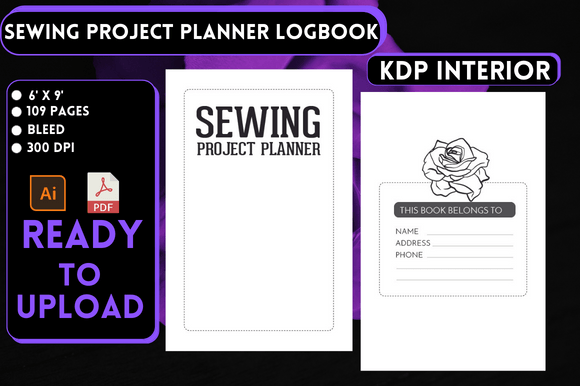
While the concept is universally helpful, the physical or digital format matters. A pre-designed, print-ready Sewing Project Planner Logbook like a tested KDP interior offers significant advantages.
- Structure Over Blank Pages: A blank journal requires you to invent your own layout every time, which can be a drain on creative energy. A pre-formatted logbook with dedicated sections for project details, materials, steps, and notes provides immediate, intuitive guidance.
- Tested for Functionality: Logbooks specifically designed and tested for platforms like Amazon KDP have undergone practical checks. The 8.5" x 11" dimension is standard and printer-friendly, the 106-page count offers ample space for multiple projects, and features like bleed ensure a professional look when printed.
- Ready for Business Use: For those selling their creations or the logbook itself, having high-resolution, print-ready PDF and AI source files is crucial. It allows for quality self-printing or seamless upload to publishing platforms without technical hurdles. The "fully tested" aspect means the interior is proven to meet platform specifications, avoiding formatting rejections.
A potential limitation to consider is rigidity. Some highly intuitive sewists might initially feel constrained by a structured template. However, most find that the framework actually liberates them from administrative chaos, freeing their mind for the creative act of sewing itself. The key is to view the logbook as a flexible servant to your process, not a rigid master.
The Unseen Benefit: The Journey Documented
Perhaps the most profound benefit of a Sewing Project Planner Logbook isn't just the finished garment, but the documented journey. It becomes a tangible archive of your growth as a maker. Flipping through past projects, you see your skills evolve, your taste refine, and your accomplishments accumulate. It turns a series of isolated sewing sessions into a cohesive, proud narrative of your craft. For anyone who sews—whether to relax, to create heirlooms, or to build a business—this planner moves you from working in the fog to working in the light, with every measurement, idea, and triumph recorded and ready to guide your next beautiful creation.