Streamlining Custom Apparel Sales with a Professional Order Form Interior
The world of independent publishing on Amazon KDP has expanded far beyond traditional books. Creators and small businesses are leveraging the platform to sell a wide array of practical and creative tools, including specialized forms and templates. Among these, a well-designed T Shirt Order Form KDP Interior has emerged as a valuable asset for anyone managing custom apparel sales, from small event organizers to growing online merch stores.
The Core Function of an Order Form Interior
At its heart, this type of product is a pre-designed, printable document system. It serves as the administrative backbone for a custom t-shirt business. Unlike a generic notebook or blank journal, its pages are structured with specific fields and sections dedicated to capturing all the necessary details of a t-shirt order. This transforms a simple blank book into a professional business tool.
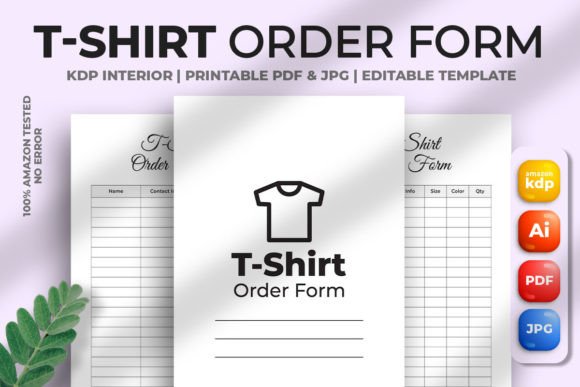
The primary purpose is to replace ad-hoc methods like scribbled notes, disparate emails, or inconsistent digital forms with a unified, physical, and repeatable system. When you use a dedicated T Shirt Order Form KDP Interior, every customer order is recorded in the same format. This includes essential details like customer name and contact information, order date, shirt size (S, M, L, XL, etc.), quantity, color selection, design specifics or SKU, price, payment status, and delivery notes.
Key Characteristics of a Professional Template
When evaluating or utilizing such a template, several design and technical characteristics are crucial for its effectiveness. A template described as a fully vector editable PDF is particularly powerful. Vector graphics mean the design elements are based on mathematical paths rather than pixels. This allows for infinite scalability without any loss of quality. You can open the file in Adobe Illustrator and adjust not just the content, but potentially the layout itself—changing column widths, moving field positions, or even altering decorative elements to better match your brand.
The mention of being 100 tested on Amazon KDP no error speaks to a critical practical consideration. Amazon’s print-on-demand service has specific technical requirements for uploaded interiors, including precise dimensions, margin settings, and file formatting. A template that has been thoroughly tested ensures it will upload without rejection, generate a print preview correctly, and result in a physically usable printed book with all pages and text properly aligned. This saves creators significant time and frustration.
Other noted features like a 6 x 9 inches size, 120 pages, and no bleed are standard specifications for many KDP interiors. The 6x9 size is a popular and economical book dimension. The 120-page count provides substantial capacity for recording many orders. "No bleed" indicates that the design does not require graphics or ink to extend to the very edge of the page, which simplifies the printing process and is appropriate for a functional form-based interior.
Real-World Applications and User Scenarios
The utility of this tool spans a diverse range of users, aligning perfectly with a broad audience of creators and business owners.
- Small Event Organizers: For school fundraisers, community sports teams, or family reunions where custom shirts are made, a physical order form book provides a centralized, reliable place for volunteers to collect orders on-site, avoiding lost paperwork.
- Online Merch Creators: Artists, podcasters, YouTubers, or writers selling branded apparel through social media or small webstores can use the printed book to manually track orders received via direct messages or comments before processing them in a bulk order to a manufacturer.
- Local Custom Print Shops: Even small local businesses that handle walk-in customers for custom t-shirts can use this as a formal order-taking pad, improving professionalism and ensuring all client specifications are clearly captured.
- Crafters and Hobbyists: Individuals who make shirts for gifts or small-scale sales at craft fairs benefit from having an organized system to manage their projects, materials needed per order, and delivery timelines.
In each scenario, the shift from digital to physical—or the standardization of a physical process—reduces errors. A clearly labeled field for "Shirt Color" prevents misunderstandings compared to a free-form note. A dedicated column for "Payment Status" (Paid, Deposit, Due) improves cash flow management.
The Advantage of a Structured Workflow
Implementing a standardized form interior introduces a structured workflow into what can often be a chaotic process. Consider the typical steps: order intake, specification clarification, payment tracking, production scheduling, and fulfillment. When each of these steps has a designated place on a form page, the entire operation becomes more manageable.
For example, you might dedicate the first page of your form book to an order summary log, simply listing order numbers and customer names. Subsequent pages are the detailed forms. This allows for quick reference. The high-resolution, print-ready nature of the file ensures that when the book is printed—whether through KDP or a local printer—the text is sharp and legible, and the pages are durable for daily use.
The ability to change the size easily because it is a vector file also offers long-term flexibility. If your business grows and you decide to offer a larger, notebook-style order form, or a smaller, pocket-sized version for events, the core design can be adapted without starting from scratch, preserving your established layout and branding elements.
Considerations for Implementation and Use
While the advantages are clear, successful implementation requires some forethought. The description notes the product is ready for notebook, journal, diary. This highlights that the interior is the content; the user must combine it with a cover. On KDP, this means creating or selecting a suitable cover design that reflects the business's purpose—perhaps labeled clearly as "T-Shirt Order Log" or "Custom Apparel Sales Forms."
The 100 vector editable resizable PDF feature is a significant benefit, but it presupposes the user has access to and some familiarity with software like Adobe Illustrator or another vector-editing tool. For users without such software, the provided high-resolution JPG at 300 DPI could be used as a static background in simpler layout software, though editing would be more limited.
Another consideration is scalability. A 120-page book might be perfect for a season of sales or a specific event. Users should estimate their order volume to determine how many books they might need to publish. Since it's a low or no-content book (the content is the unchanging form structure), it can be listed as a perpetual product on Amazon, ordered in batches as needed.
Beyond the Basic Form: Potential Adaptations
The concept of a T Shirt Order Form KDP Interior also opens the door to broader thinking about specialized business tools. The underlying principle—a pre-formatted, printable, repeatable system for capturing transaction data—can be applied to many other micro-business needs. A creator familiar with editing the vector file could adapt the same template framework for other custom products like mugs, hats, or posters, simply by changing the field labels from "Shirt Size" to "Mug Style" or "Hat Size."
This adaptability underscores the product's value as more than just a single-use template; it's a methodology for systematizing a hands-on business process. The expertise indicated by the description, mentioning a professional global creative collective with over 10 years of experience, ideally translates into a design that considers not just aesthetics, but logical information hierarchy and real-world usability—factors like font size for readability, spacing for handwritten entries, and a layout that guides the user naturally from one field to the next.
Ultimately, incorporating such a tailored tool into a business operation moves it away from improvisation and toward professionalism. It reduces the cognitive load on the seller, minimizes errors that can cost time and money, and presents a more organized face to the customer. Whether used by a hobbyist selling a few dozen shirts or a small business managing hundreds of orders, the structure and clarity provided by a dedicated, well-designed order form interior can be a simple yet transformative element in the successful management of custom apparel sales.