Cultivating Confidence: The Rising Demand for Structured Self-Love Resources
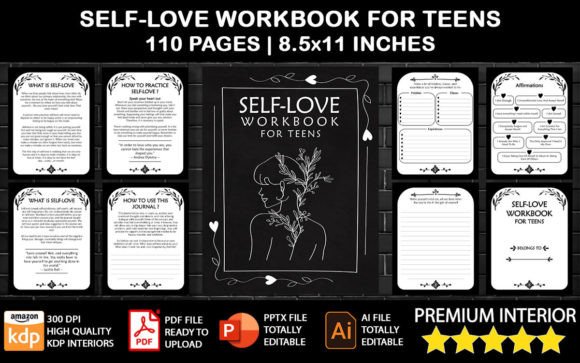
The landscape of personal development content has evolved significantly, shifting from broad, generalized advice to targeted, actionable tools. Among these, resources like the Self Love Workbook for Teens represent a focused response to a growing and specific need. This workbook is not merely a journal; it is a structured guide featuring over 50 prompts, exercises, and positive affirmations designed to help adolescents move from doubt and insecurity towards self-acceptance and empowerment. At its core, it operates on a vital principle: you need love from yourself as much as from others. Without addressing foundational issues of self-esteem and confidence, it becomes impossible for individuals to engage fully with their personal, academic, or future professional lives.
Aligning with Macro Trends in Wellness and Content Consumption
The relevance of such a tool extends far beyond its immediate audience. It intersects with several dominant trends observed by professionals, creators, and marketers. First, the wellness industry continues its pivot towards preventative and foundational mental health. Rather than focusing solely on crisis management, there is a proactive emphasis on building emotional resilience from a young age. Secondly, consumer preference, especially among younger demographics, has shifted towards interactive and participatory content. Passive reading is often insufficient; engagement through writing, doodling, and self-reflection, as facilitated by the workbook's free space and prompts, drives deeper adoption and value.
From a content creation and business perspective, this workbook exemplifies the productization of specialized knowledge. It transforms psychological and coaching principles—like positive affirmations and self-reflective prompts—into a tangible, reproducible format (a 110-page, 8.5×11 inch resource). This meets a market expectation for scalable, accessible, and private tools that individuals can use independently, fitting into busy or non-linear workflows without requiring constant facilitator involvement.
The Operational Design: Why Structure Matters
What makes the Self Love Workbook for Teens noteworthy for enthusiasts and entrepreneurs analyzing successful content formats is its deliberate architecture. It provides a guided path, not an open-ended void. The inclusion of specific instructions and sequenced exercises offers a framework that reduces the intimidation of starting a self-love practice. This structured approach mirrors effective learning and development models used in professional settings, applying them to personal emotional growth.
For the freelance creator or marketer, understanding this design is insightful. The workbook’s interior files—offered as both a ready-to-upload PDF and an editable PPT file—along with editable cover files (AI, EPS), speak to a dual audience: the end-user (the teen) and the distributor (the professional). This acknowledges a workflow where customization and branding are often necessary for coaches, schools, or content platforms to integrate such resources into their unique offerings. It's a product built for both consumption and further creation.
Connecting Self-Love to Professional and Creative Potential
A forward-looking perspective recognizes that foundational self-worth is not a separate lifestyle topic but a bedrock for professional and creative capacity. Teens grappling with low self-esteem or self-hatred are unlikely to develop the confidence needed for public speaking, pitching ideas, sharing creative work, or collaborative entrepreneurship later in life. Tools that help them "uncover beautiful things about themselves," as the workbook aims to do, are indirectly investing in future innovation and leadership.
The workbook’s emphasis on transforming attitude, emotions, and overall outlook is inherently practical. Each prompt is a micro-exercise in cognitive reframing, a skill highly transferable to problem-solving in business and technology. When a young person learns to challenge self-doubt through written affirmations, they are practicing a form of iterative self-feedback, a process akin to debugging a project or revising a strategic plan.
Observations on Market Needs and Content Evolution
The growing attention to resources like this reflects changing needs. The digital age, while connecting teens to vast information, has also amplified comparisons and insecurity. A physical or digital workbook provides a focused, offline-reflective counterbalance. Furthermore, the expectation for resources has moved from being purely informational to being experiential and transformative. Users, and the professionals supplying them, seek tools that promise a measurable outcome—a path from point A (insecurity) to point B (self-love)—not just a collection of advice.
This aligns with broader developments in edtech and wellness tech, where the integration of journaling, prompt-based learning, and progress tracking is becoming commonplace. The Self Love Workbook for Teens, in its printable and editable format, sits at a pragmatic intersection of this trend, offering technology-compatible files without demanding a specific app or platform, thus ensuring wide accessibility.
The Bottom Line for Creators and Professionals
Analyzing such a resource offers key insights. First, niche, problem-specific content (like targeted teen self-love) holds significant value in a saturated market of general self-help. Second, the packaging of professional knowledge into user-friendly, self-guided formats is a scalable business model. Third, the technical provision of editable source files (PPT, AI, EPS) is a critical feature that meets the advanced needs of resellers, coaches, and organizations, allowing them to adapt and integrate the content seamlessly.
Ultimately, the Self Love Workbook for Teens is more than a journal. It is a case study in how to address a profound human need—building self-love—with a professional, structured, and market-aware approach. It recognizes that transforming one's inner world is the first step toward engaging fully with the outer world, a principle as relevant for a teenager sketching their future as it is for an entrepreneur building a company. For the savvy professional, its existence and design highlight where content, wellness, and practical tool creation are successfully converging.